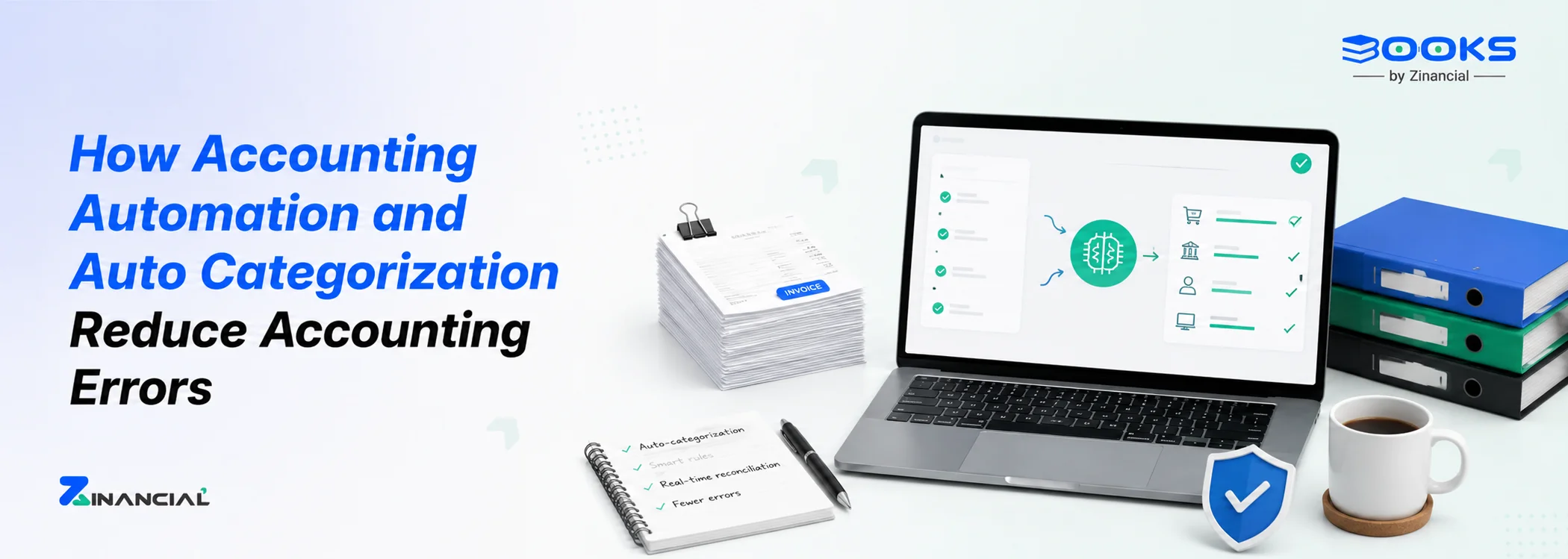
Every accounting system depends on one thing: clean transaction data. Yet most businesses still struggle with bookkeeping errors caused by manual entry, inconsistent categorization, and missed transactions. This is where accounting automation changes the workflow. Modern accounting platforms use auto categorization to classify transactions automatically using bank rules, machine learning, and AI.
Instead of manually assigning every expense or income entry, the system categorizes transactions instantly. The result is stronger financial accuracy, cleaner books, and faster closing cycles.
More importantly, it directly answers a critical question many finance teams ask: how automation reduces accounting errors in daily bookkeeping operations.
Platforms like Zinancial Books integrate automated transaction classification with intelligent rules, allowing businesses to maintain reliable financial records without constant manual oversight.
Manual bookkeeping introduces errors long before reports are generated. Small typing mistakes can cascade into inaccurate financial statements.
Accounting automation reduces these risks by removing repetitive data entry tasks. AI‑driven systems can reduce processing errors by up to 95% and cut processing time by 50%, according to an industry study.
Here’s how auto categorization eliminates common bookkeeping errors:
- Reduced typing mistakes
Manual entry often leads to transposed numbers or skipped transactions. Automated tools extract data directly from receipts and invoices using OCR technology.
- Consistent categorization rules
Different team members often classify the same expense differently. Automated systems apply predefined rules to ensure consistent expense categories.
- Duplicate transaction prevention
Automated platforms analyze vendor names, transaction amounts, and dates. If a duplicate appears, the system flags it before it enters the books.
These improvements strengthen financial accuracy because the system treats every transaction consistently.
Accounting tools like Zinancial Books automate this process by syncing bank feeds and applying rule-based categorization to incoming transactions. This reduces manual intervention while keeping financial records organized.