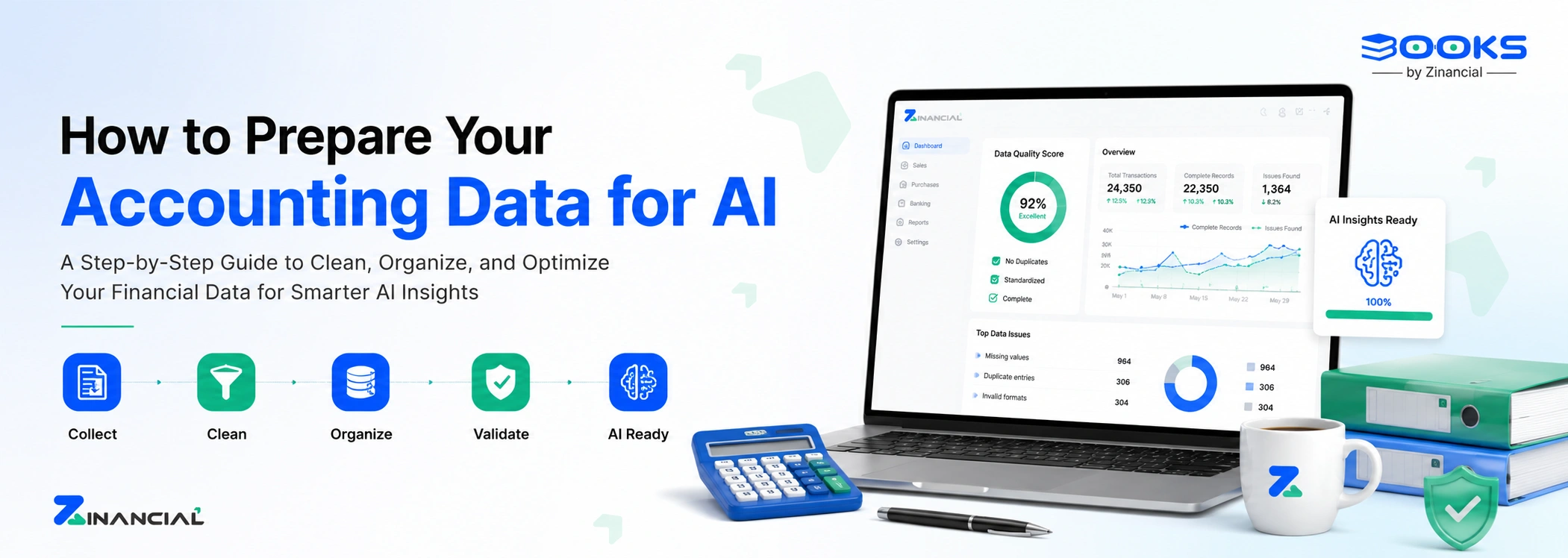
AI in finance delivers results only when the foundation is strong. That foundation is accounting data for AI that is clean, structured, and consistent.
Many businesses invest in AI tools expecting faster closes and better insights. Instead, they run into inaccurate reports and inconsistent outputs. The problem is not the technology. It is the data.
True AI readiness begins with preparing your financial data before introducing automation. If you are working through how to prepare accounting data for AI tools, the focus should not be just on improving data quality. But also, structuring inputs properly, and aligning your accounting systems for consistency.
According to a survey by EY, 46% of financial services leaders say AI helps reduce risk through better data processing, highlighting its role in improving accuracy and decision-making.
AI systems depend entirely on input quality. If your financial data is inconsistent or incomplete, the outputs will reflect those gaps.
Poor data quality often leads to:
- Misclassified transactions
- Inconsistent reports
- Weak forecasting accuracy
In contrast, well-prepared accounting data for AI allows systems to process transactions accurately and generate reliable insights.
The challenge is that most accounting systems allow flexible data entry. Over time, this creates variations in formats, naming, and structure.
This is why many modern accounting workflows are shifting toward structured data environments where inputs are standardized at the source. Tools designed with this approach, such as Zinancial Books, help reduce inconsistencies early and make financial data more reliable for AI-driven use cases.
According to PwC’s Digital CFO study, 73% of CFOs consider digitalisation of the finance function a high priority, highlighting the growing focus on automation and AI-driven processes.
Step 1: Clean and Standardize Your Data
Cleaning and standardizing data is the first step toward AI readiness. Without this, AI outputs remain unreliable.
Start by identifying duplicate entries across your financial records. Duplicate invoices or repeated transactions distort reporting and mislead AI models.
Focus on improving accuracy by:
- Removing duplicate transactions across ledgers
- Correcting incorrect values and mismatched totals
- Reconciling entries with bank statements
Once errors are addressed, standardization becomes essential.
Ensure consistency across:
- Date formats such as YYYY-MM-DD
- Currency values and symbols
- Numerical formats across all reports
Uniform naming conventions are often overlooked but critical. Variations such as “ABC Ltd” and “ABC Limited” should be standardized into one format.
Apply this across:
- Vendors
- Customers
- Ledger accounts
In practice, maintaining this level of consistency manually becomes difficult as data grows. This is where structured accounting platforms that enforce standardized inputs, including Zinancial Books, help reduce variation at the source and improve data quality over time.
Step 2: Structure Your Data for Machine Readability
Once your data is clean, it needs to be structured for AI systems to process efficiently. This is a core part of how to prepare accounting data for AI tools.
AI models require structured formats. Unstructured files such as PDFs or scanned documents limit usability.
Move your data into:
- CSV files for easy processing
- Excel (XLSX) for structured tabular data
At the same time, address common spreadsheet issues:
- Remove merged cells
- Eliminate hidden rows and columns
- Avoid sub-headers within tables
- Delete unnecessary blank spaces
Column headers must remain consistent across datasets. For example, “Invoice Date” should not appear as “Date of Invoice” elsewhere.
A structured dataset should behave like a clean table rather than a formatted report. This improves compatibility across accounting systems and AI tools.
As businesses move toward automation, many adopt systems that maintain structured data formats by default. Zinancial Books is one such solution that ensures financial records remain machine-readable without requiring extensive manual cleanup.
Step 3: Consolidate and Centralize Your Data
Fragmented data limits AI readiness. When data is spread across multiple tools, AI cannot generate a complete picture.
Most businesses manage data across:
- Bank feeds
- POS systems
- Billing tools
- Spreadsheets
Bringing this data into one centralized system is essential.
The objective is to create:
- A single source of truth
- Consistent reporting across teams
- Unified financial visibility
Master data ensures consistency during consolidation.
Maintain standardized records for:
- Vendors
- Customers
- Chart of accounts
Without this, the same entity may appear multiple times, reducing data quality and affecting insights.
To address this, businesses are increasingly moving toward unified accounting environments that bring multiple data streams together. Zinancial Books supports this approach by helping consolidate financial data into a structured and consistent system.
Step 4: Address Unstructured Data Using OCR
A large portion of financial data exists in unstructured formats such as invoices and receipts. These are often stored as PDFs or images, which AI cannot process directly.
OCR technology converts this data into structured formats.
It helps by:
- Extracting key fields like invoice numbers and amounts
- Converting scanned documents into usable text
- Structuring data for further processing
Without OCR:
- Manual entry increases workload
- Errors become more frequent
- Data remains inconsistent
With OCR, unstructured data becomes part of your usable accounting data for AI, improving overall data quality.
Many modern accounting tools now include document capture and digitization capabilities to handle this transition. Zinancial Books enables this by integrating document workflows into the accounting process, reducing dependency on manual entry.
Step 5: Establish Strong Data Governance
Data preparation must be maintained over time. Without governance, consistency breaks down quickly.
Start by mapping how your data flows across systems. Understand where it originates, how it is processed, and how it is used.
Define clear processes for:
- Data entry and validation
- Account mapping rules
- Data transformation
Access control is equally important.
Implement role-based access to:
- Prevent unauthorized edits
- Protect sensitive financial data
- Maintain data integrity
Establishing clear standards ensures consistency across teams and improves long-term AI readiness.
To support this, businesses often rely on systems that combine structured workflows with access control. Zinancial Books helps maintain this balance by ensuring data consistency while allowing controlled access across teams.
Step 6: Review, Validate, and Test Before Scaling
Before scaling AI, validation is essential. Even well-prepared accounting data for AI requires testing.
Maintain audit trails to track changes in:
- Master data
- Transaction records
- Mapping rules
Audit trails help identify issues quickly and ensure accountability.
Testing should begin with smaller datasets.
Evaluate:
- Accuracy of categorization
- Consistency in reports
- Reliability of outputs
This approach allows issues to be resolved before scaling.
Skipping this step often leads to large-scale errors that are difficult to correct.
Systems that provide visibility into data changes make this process more manageable. Zinancial Books supports traceability, making it easier to validate and refine data before full AI implementation.