If you are deciding between accounting software vs ERP, you are facing a practical business choice. You want to manage costs, reduce tool sprawl, and support growth without slowing your team. The right system should fit how your business operates today, not how vendors think it should.
Many companies adopt ERP before it is truly needed. Others stick with lightweight accounting tools too long and face reporting gaps or process slowdowns. This guide compares ERP vs accounting software based on actual workflows, operational requirements, and cost trade-offs.
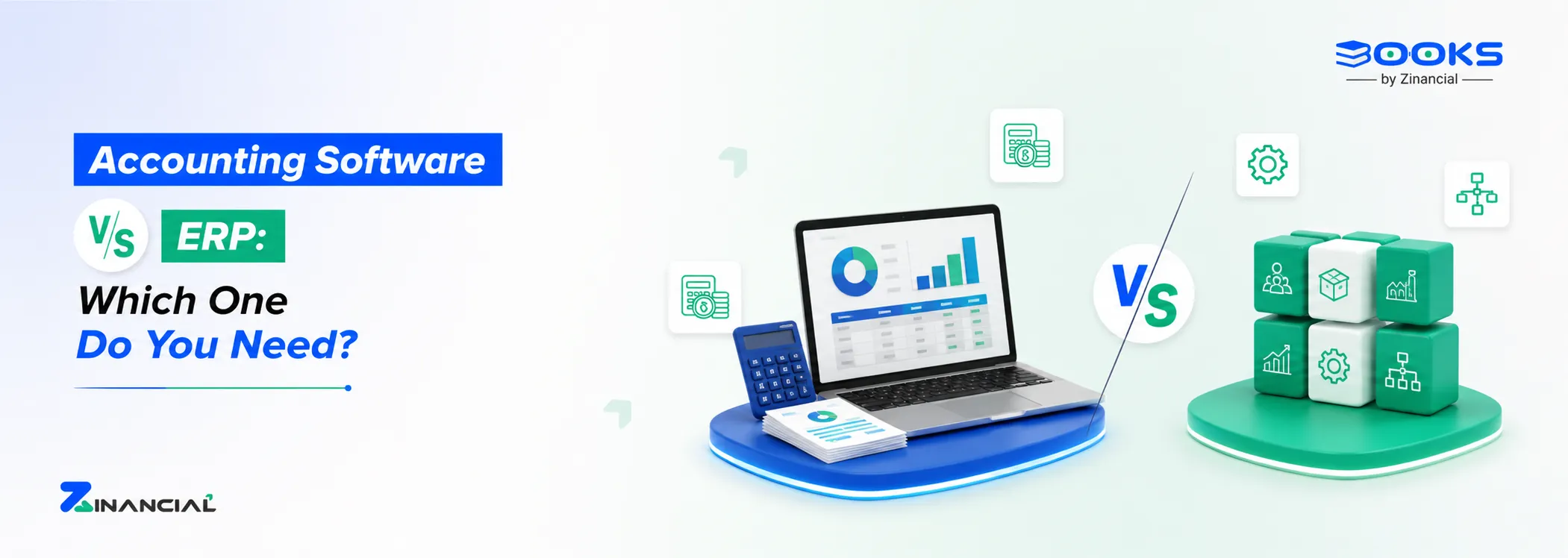
Accounting software is built to manage precise financial records. ERP is built to oversee how the entire business functions.
Accounting software focuses on transactions, records, compliance, and reporting. ERP connects finance with inventory, HR, procurement, sales, and operations in one shared system.
So, if accounting software is the control center for your finances, ERP is the backbone that keeps your entire business running. One keeps your books error-free; the other coordinates how teams collaborate efficiently.
Functional overview:
Let’s compare accounting software vs ERP across the features that matter most to growing businesses.
| Area |
Accounting Software |
ERP |
| Core Accounting |
Yes |
Yes |
| Financial Reporting |
Yes |
Yes |
| Payroll |
Yes (Add-on Available) |
Yes |
| Inventory Management |
Limited |
Advanced |
| Procurement |
Rare |
Yes |
| CRM / Sales |
Rare |
Yes |
| HR Management |
Basic / None |
Full |
| Operations Workflows |
No |
Yes |
Accounting software answers financial questions. ERP answers process and operational questions. The choice depends on the challenge you need to solve.