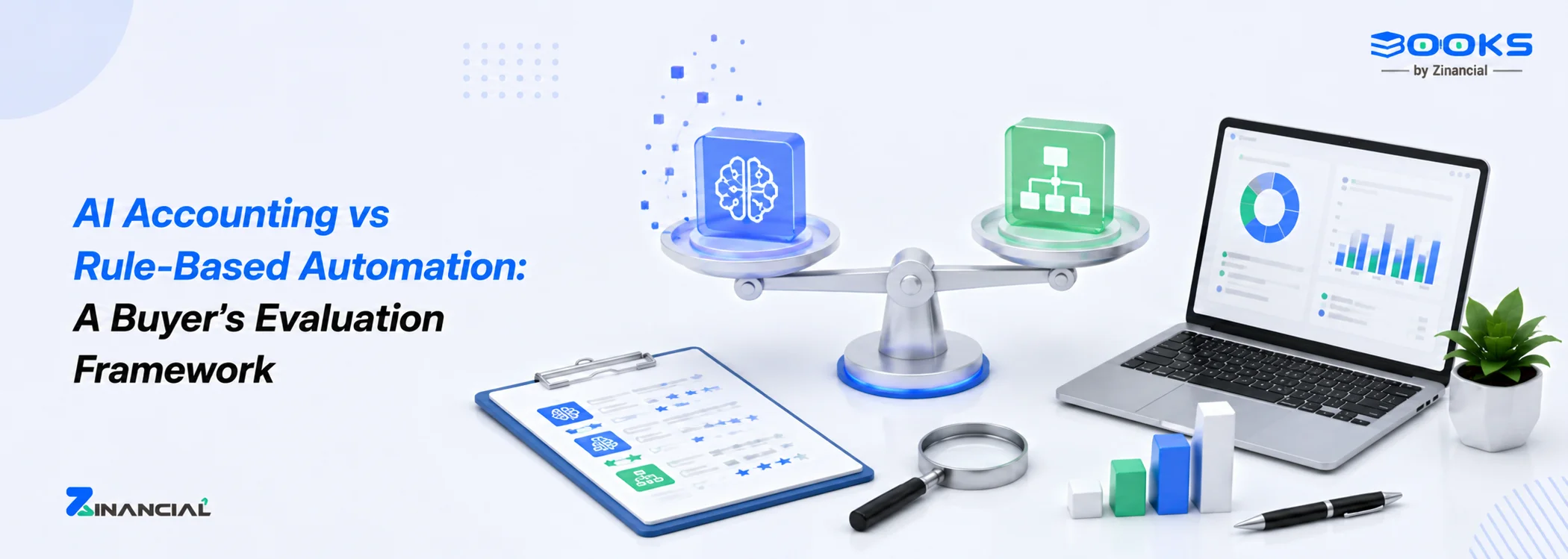
If you are comparing AI accounting vs automation which is rule based, you are no longer gathering definitions. You are assessing whether your current accounting structure can absorb growth without creating new review work.
Platforms like Zinancial Books position themselves within the AI accounting Software category, designed to layer on top of existing ERP systems and reduce the need for expanding rule libraries as complexity increases. They represent a structural shift in how ruled based automation scales, not just a feature upgrade.
This framework breaks the comparison into distinct evaluation lenses. Each section isolates a specific concern finance leaders examine when deciding whether to remain with rule based accounting or move toward adaptive systems. The goal is to help you evaluate fit based on operational reality, not generic capability claims.
Rule based accounting automation operates on explicit logic. You define the conditions. The system executes them.
Examples:
- If vendor contains “AWS” → categorize as Software Expense
- If invoice is under $1,000 → auto-approve
- If intercompany transaction matches entity pair → eliminate
The system does exactly what you configure. Nothing more. Nothing less.
Strengths of Rule-Based Systems
- Easy to explain in audits
- Low computational overhead
Limitations
- Every new scenario requires a new rule
- Exceptions create manual overrides
- Maintenance grows with complexity
If transaction patterns are stable, rule based accounting is efficient and cost-effective. It performs extremely well in controlled environments where variability is low.
The friction appears when behavior changes faster than the rule library can adapt.