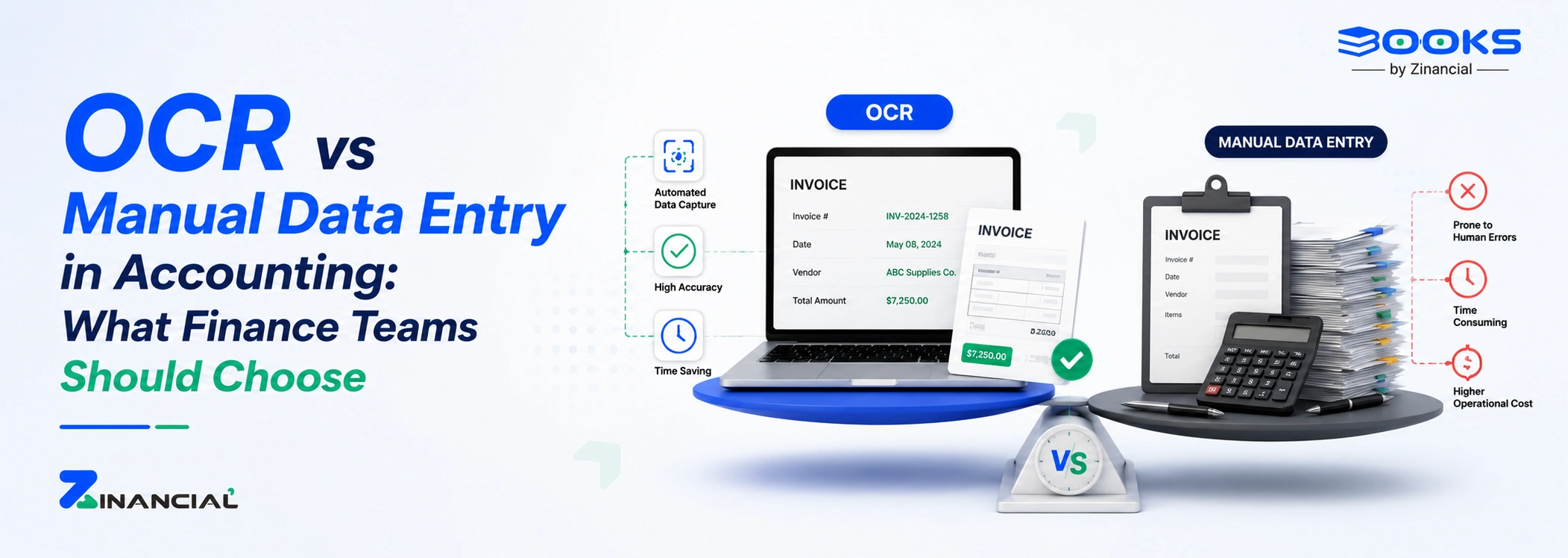
Every accounting process starts with one step. Entering financial data. That is why many finance teams are comparing bold OCR vs manual entry methods to improve bookkeeping workflows.
Invoices, receipts, vendor bills, and bank statements all require accurate input before they appear in financial reports. When this process is slow or error-prone, reporting delays follow.
Traditional typing methods often slow down operations, while bold data entry automation technologies now capture financial information instantly.
The shift is simple. Businesses want better bold accounting efficiency and fewer human errors. As a result, bold finance automation tools that use OCR are replacing manual processes across accounting teams.
This article explains the differences between bold OCR vs manual accounting data entry, where each method works best, and how modern tools like Zinancial Books improve financial data capture.
Manual entry has been the backbone of bookkeeping for decades. Accountants read invoices, receipts, and transaction records, then type the information into accounting systems.
While this method is familiar, it requires time and concentration.
Typical manual accounting workflows include:
- Reading vendor invoices
- Typing amounts into accounting systems
- Assigning expense categories
- Verifying tax information
- Rechecking totals
This process creates several limitations.
First, manual typing slows down financial operations. Large companies process hundreds of invoices daily. Even small firms handle dozens.
Second, human error is unavoidable. A mistyped amount or wrong category can distort financial reports.
This is why many finance teams are evaluating bold OCR vs manual entry to improve bold accounting efficiency.
Features like Smart Bill Capture automatically extract invoice data from scanned documents, helping finance teams reduce manual typing and improve data entry automation.