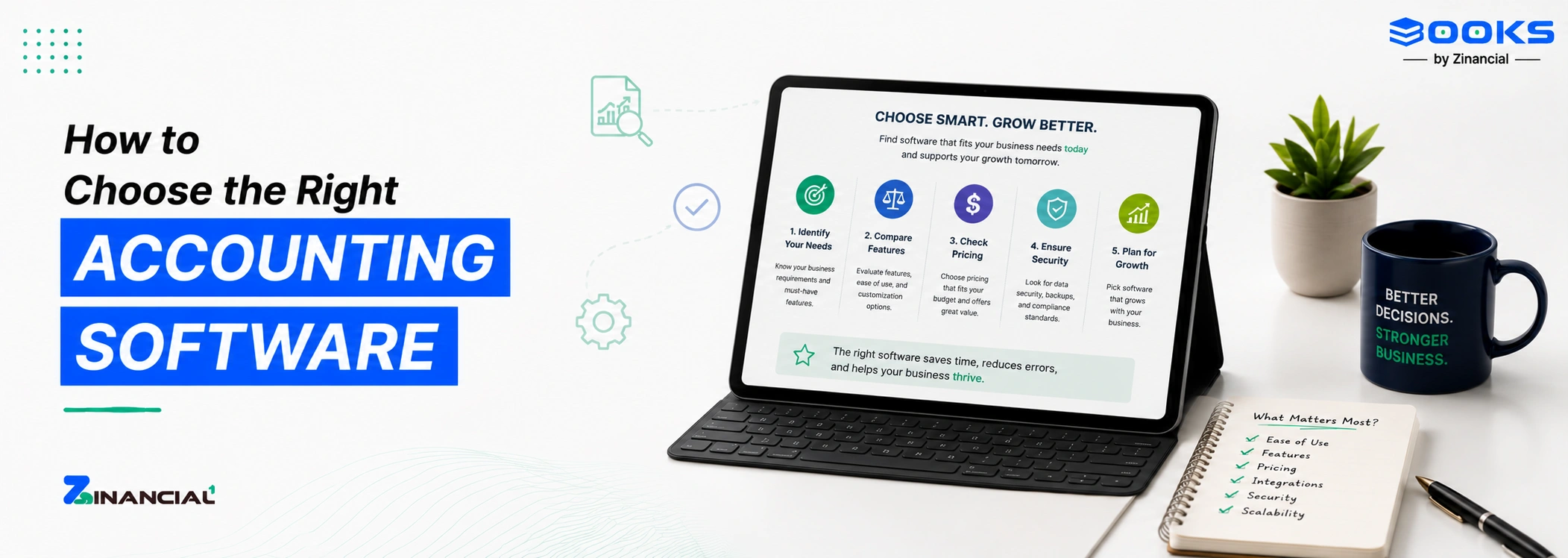
There is no single platform that works best for every business. The strongest choice depends on your industry, size, sales channels, and tax complexity. Here are five solutions worth considering in 2026.
Best for: Growing businesses seeking integrated accounting and sales tax management
Zinancial Books brings accounting and sales tax management into one connected platform. This helps growing businesses run their finances without juggling disconnected systems.
Businesses can manage core accounting tasks alongside sales tax workflows. Everything stays tied to the same financial records. This removes the constant back and forth between separate accounting and tax tools.
That connected approach works well for small and growing businesses. They need strong financial visibility, without taking on the weight of enterprise-only tax technology.
Zinancial Books also includes reporting tools that show real financial performance clearly. Business owners get useful visibility while handling everyday accounting and compliance together.
Businesses searching for sales tax software for small business needs want something simple. An integrated platform like this offers a genuinely simpler path forward. It brings accounting, reporting, and sales tax management into one connected environment.
Key strengths:
- Integrated accounting: Businesses manage accounting and sales tax workflows inside one connected financial platform.
- Financial visibility: Reporting tools help businesses understand performance and compliance status at a glance.
- Simple workflows: Keeping finance and tax together reduces constant switching between separate software tools.
- Business fit: The platform supports growing businesses that need more than basic bookkeeping software alone.
Potential limitation:
Some businesses eventually scale into highly complex, multi-country tax situations. They may explore additional specialized modules alongside Zinancial Books. Most growing businesses, however, find everything they need within the platform itself.
2. Avalara
Best for: Mid-market and enterprise businesses with complex tax requirements
Avalara is a broad tax automation platform built for complex tax obligations. Its capabilities span tax calculation, compliance, filing, and related workflows across jurisdictions.
Its AvaTax engine determines applicable rates using transaction details, product data, and location. The platform supports tax calculations across more than 12,000 US tax jurisdictions.
Avalara connects with many ecommerce platforms, ERP systems, and business applications. These integrations help businesses bring tax calculations into existing financial workflows.
The platform also supports automated returns filing and exemption certificate management. Businesses expanding into new states can use registration services to open tax accounts.
Key strengths:
- Broad coverage: Avalara supports sales tax requirements across thousands of US jurisdictions, with international capability.
- Deep integrations: Pre-built connections support many ecommerce, ERP, billing, and business applications.
- Compliance depth: The platform covers calculations, filing, exemption certificates, and related workflows.
- Enterprise fit: Its functionality suits businesses with high transaction volumes and complex operations.
Potential limitation:
Avalara can be genuinely complex to implement and manage, especially for smaller teams. Usage-based pricing and add-on services often make total costs hard to predict.
3. TaxJar
Best for: Ecommerce businesses managing sales tax
TaxJar automates sales tax for ecommerce and online businesses. It connects with platforms such as Shopify, Amazon, WooCommerce, and BigCommerce.
The platform calculates sales tax using transaction details, customer location, and product type. This helps online sellers manage tax across multiple sales channels.
TaxJar also offers AutoFile for automated returns filing in supported jurisdictions. Its economic nexus monitoring tracks sales activity and flags potential filing obligations.
Its ecommerce focus makes TaxJar relevant mainly for online retailers and marketplace sellers. Businesses with broader accounting needs may still require a separate finance platform.
Key strengths:
Ecommerce integrations: Connections with popular online stores can simplify sales tax management across sales channels.
- Automated filing: Auto filing feature helps businesses prepare and submit sales tax returns where supported.
- Nexus monitoring: Businesses track sales activity and get alerts near economic nexus thresholds.
- Simple setup: Its focused approach helps smaller ecommerce sellers get started quickly.
Potential limitation:
TaxJar focuses mainly on US sales tax, with limited international coverage. It also handles tax alone, without the broader accounting tools many businesses need.
4. Anrok
Best for: SaaS and subscription-based businesses
Anrok is built specifically for SaaS and technology companies. This focus addresses complex taxability rules around software subscriptions and digital products.
The platform automates sales tax workflows and integrates with billing systems. This helps technology companies manage tax as they expand into new states.
Anrok also supports integrations with platforms such as Stripe and Chargebee. Its API-first approach suits companies wanting tax tied to their own systems.
Its specialized focus is a clear advantage for pure software businesses. Companies selling physical products may need a more general finance platform instead.
Key strengths:
- SaaS expertise: The platform addresses taxability challenges tied to software, subscriptions, and digital products.
- Billing integrations: Connections with modern billing platforms help automate tax within revenue workflows.
- Developer-friendly: An API-first approach suits technology teams building their own systems.
- Specialized automation: Its focused design reduces manual tax work for recurring software revenue.
Potential limitation:
Anrok suits SaaS billing well, but offers little for physical product sales. Businesses outside pure software may find its scope too narrow.
5. Vertex
Best for: Large businesses with complex tax operations
Vertex provides enterprise tax technology for sophisticated indirect tax needs. Its solutions cover sales tax, use tax, VAT, GST, and related obligations.
The platform offers both cloud and on-premise deployment options. This suits large organizations with specific infrastructure requirements.
Vertex integrates deeply with major ERP systems, including SAP and Oracle. This allows tax determination within established enterprise workflows.
The platform also provides tax analytics and reporting tools. These help large organizations monitor liabilities and compliance risks closely.
Key strengths:
- Enterprise integration: Deep connections with major ERP systems embed tax calculations into existing workflows.
- Global coverage: The platform supports indirect tax requirements across thousands of jurisdictions worldwide.
- High-volume processing: Its infrastructure handles complex tax operations and large transaction volumes.
- Tax analytics: Reporting tools offer visibility into liabilities and jurisdiction-specific obligations.
Potential limitation:
Vertex is built mainly for large, complex enterprise operations. Its implementation timeline and enterprise pricing make it a difficult fit for smaller businesses.