As your business grows, your financial decisions move faster. You hire sooner, invest earlier, and commit to vendors with more confidence. At that stage, real-time cash flow tracking becomes less about fixing problems and more about staying aligned with momentum.
If you are exploring how to track cash flow in real time, you likely want clearer day-to-day awareness. You want numbers that reflect what is happening now, not what closed last month. That level of financial visibility supports steady growth.
Leading advisory firms continue to emphasize liquidity discipline. Deloitte notes that strong working capital management improves resilience across market cycles. This guide walks through how structured systems and modern cash flow software help you build that stability step by step.
Before implementing tools, it helps to define terms clearly.
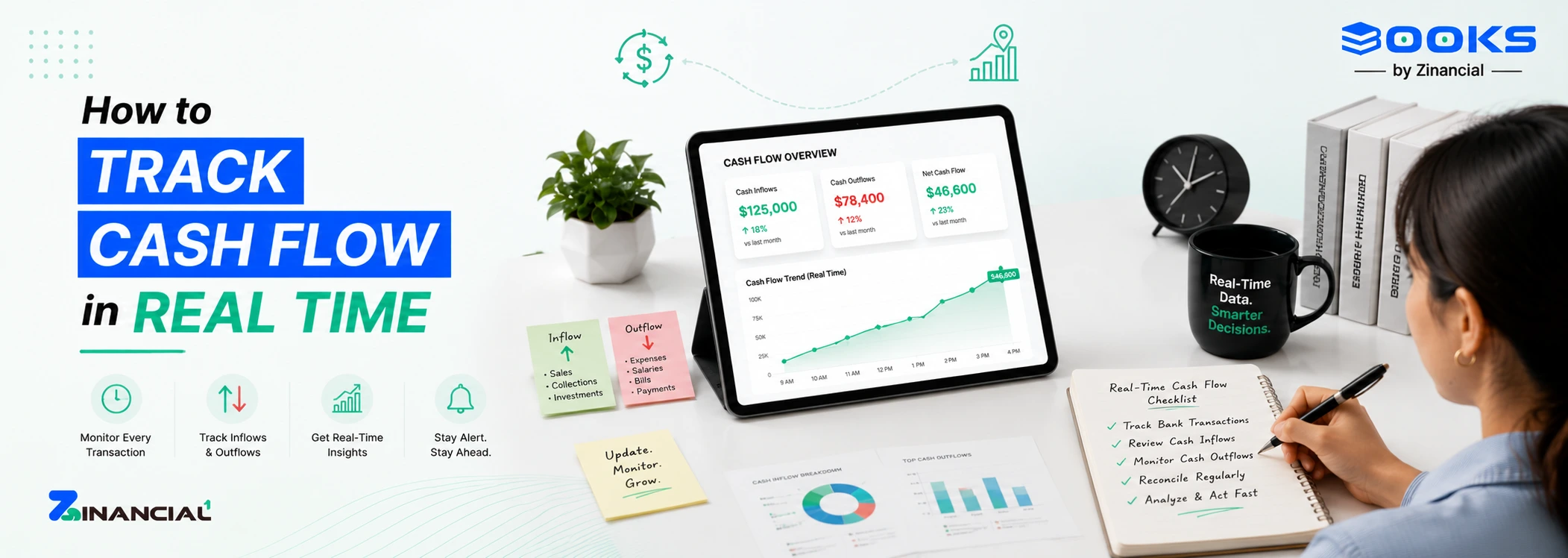
Real-time cash flow does not mean refreshing a spreadsheet daily. It means your financial data updates automatically as transactions occur. Bank feeds sync. Card transactions post. Digital payments reconcile without manual uploads.
True real-time tracking includes:
- Continuous bank integration
- Automatic transaction categorization
- Live balance updates
- Immediate visibility into receivables and payables
This structure removes manual lag. It reduces dependency on month-end reconciliation. Many businesses simplify this using tools like Zinancial Books. It connects accounts and updates cash positions automatically.
Research from Deloitte shows that companies with structured working capital monitoring maintain stronger liquidity positioning during volatility. Real-time systems are part of that structure.
When your numbers update automatically, you reduce administrative effort. You also increase response speed.
That is the starting point. Without automation, real-time tracking becomes manual work.
Start with automated account syncing inside Zinancial Books.