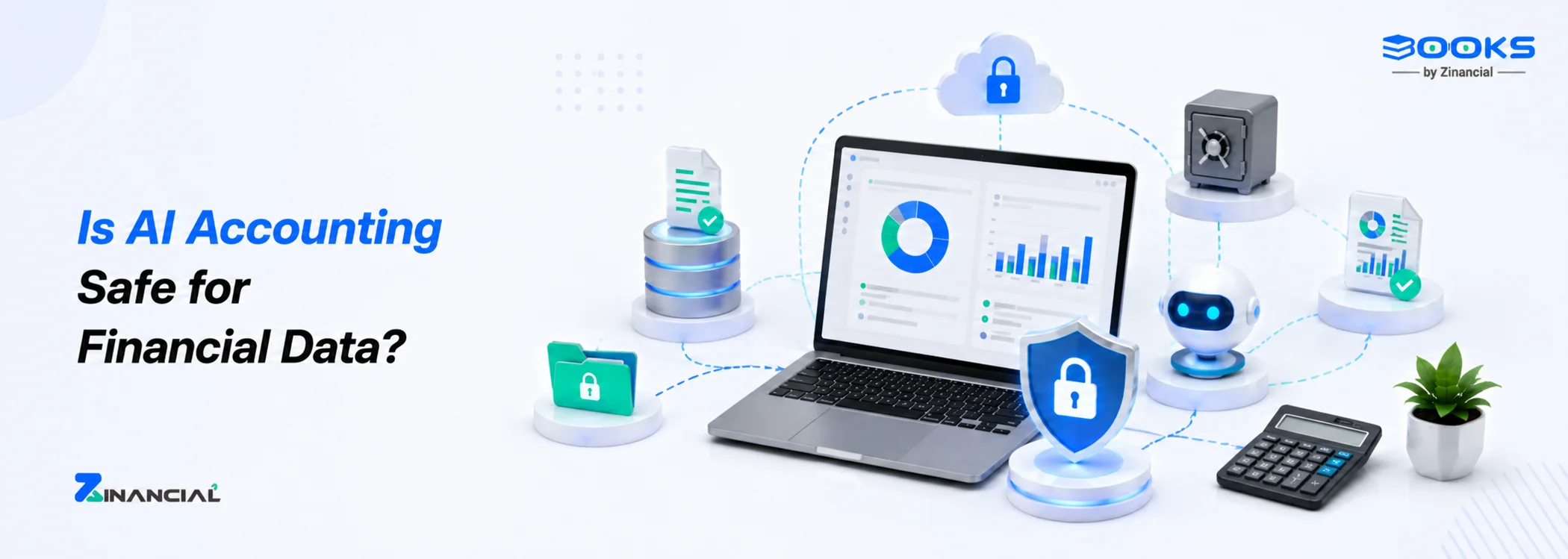
AI accounting security is no longer a side concern. You already trust software with payroll, vendor payments, tax filings, and revenue data. The real question is whether AI can manage that information without exposing you to serious AI finance risks.
If you are evaluating modern accounting systems that use AI, you are likely close to a decision. You want clarity before committing. You need to know how your data is stored, who can access it, and what happens if something goes wrong.
PwC’s Global Risk Survey consistently ranks cybersecurity and data privacy among the top risks for organizations adopting new technologies, including AI.
Safety in financial systems is measurable. It is not a branding claim or a marketing line. When we talk about AI accounting security, we are referring to specific technical and operational controls that protect your data.
This is where platforms like Zinancial Books come into focus, because they combine AI capabilities with strict control layers rather than open automation.
A secure AI accounting environment includes:
- Encryption in transit and at rest
- Role-based access permissions
- Multi-factor authentication
- Continuous activity logging
- Human validation checkpoints
Without these controls, risk increases quickly. For example, if user roles are not restricted, employees may export sensitive data without oversight. If audit logs are missing, you cannot trace changes during compliance reviews.
Here is a quick comparison:
| Risk Area |
Weak System Outcome |
Business Impact |
| Flat Access |
Anyone can export ledgers |
Internal data leaks |
| No Logs |
Changes untraceable |
Audit failure |
| Unencrypted Data |
Raw financial files exposed |
Breach liability |
| Over-Automation |
Entries post unchecked |
Compounded errors |
Most reliable AI accounting systems use AI for structured classification, reconciliation support, and anomaly detection. Zinancial Books follows this approach, while keeping high-impact actions under human control.